
The Commission ducked behind the redwood curtain to convene in Eureka from September 9-11. They tackled an agenda that included an armoring proposal along an otherwise pristine stretch of Humboldt coast, an extraordinary enforcement agreement in Malibu, and more. As always, your California policy team was on-site to advocate on behalf of our state’s ocean, waves, and beaches.
Let’s get into the highlights.
All Eyes on El Niño
Wednesday kicked off with an informational briefing on the 2026-2027 El Niño, which included a scientific overview and a warning for coastal communities to prepare for what may be the strongest El Niño event in decades. Several SoCal communities are already reeling from recent Hurricane Marie swells, which the LA Times reports as a “glimpse of what’s to come.”
At Tamarack State Beach in Carlsbad and Aliso Beach in Laguna Beach, the entire beach was lost and parking lots are crumbling into the ocean. Rail service through San Clemente was suspended yet again, as crews destroyed an ever-expanding stretch of beach by dumping boulders on it to protect the rail line. Waves pummeled homes on Beach Road in Dana Point, dragging one into the ocean and damaging 16 others (ten were red-tagged). Carlsbad, Laguna Beach, and Dana Point have all declared a local state of emergency.
Be wary of property owners - who chose to live in a hazard zone - disparaging the Coastal Commission
Moving north, crews pumped seawater from flooded Seal Beach streets, and Long Beach evacuated about 20 structures as waves shredded its boardwalk. In Malibu, a large sinkhole swallowed the driveway of a celebrity’s beachfront mansion on the aptly named Sea Level Drive, prompting city officials to evacuate 31 neighboring homes.
Meanwhile, a Kelvin wave that will temporarily raise sea levels by up to six inches is traveling toward the California coast. This is barely the first wave of El Niño-fueled events expected this winter. The damage to already-compromised coastlines could be catastrophic.
Yet these coastal cities continue to approve new construction in the very same places where existing properties are falling into the ocean. Factors like outdated zoning and the lack of a viable framework for managed retreat contribute to this untenable situation. Will beach loss and property damage wrought by this winter’s Super El Niño finally compel coastal communities, public agencies, and the state to treat coastal climate adaptation with the urgency it requires? Or will it lead to more armoring that sacrifices the public beach while temporarily protecting private property and public infrastructure, as previous El Niños have?
Hopefully the former, but more likely both. In 2022, Governor Newsom vetoed SB 1078 (Allen), a bill that would have mandated the creation of a Sea Level Rise Revolving Loan Pilot Program to help local governments buy out vulnerable coastal properties. Perhaps California’s next governor will see the need more clearly.
Surfrider gave the Commissioners an overview of the recent damage.
Commission Enforcement Secures Malibu Beachfront Parcel for the Public
An extraordinary enforcement hearing offered some inspiration for how coastal property buyouts could protect our beaches. In lieu of paying a fine for using bulldozers and excavators to brazenly steal sand and rocks from the beach to pad his property’s large seawall, a Malibu property owner offered to buy and dedicate to the public an entire beachfront parcel in eastern Malibu. He must also restore the beach and intertidal habitat in front of his Broad Beach properties, remove an unpermitted rock revetment that his crew bulldozed onto the beach, and remove an unpermitted private staircase from his seawall.
Surfrider supported the resolution through a comment letter and testimony at the hearing, and the Commission approved it. The dedication of a beachfront parcel is a rare win in a city where wall-to-wall private homes and a legacy of exclusionary practices have kept miles of coastline out of reach for the millions of Angelenos living less than an hour away. Like many others along the beach, the house that once stood there burned in the Palisades Fire. Its dedication to the public will ensure continued beach access around Big Rock Beach, even as properties are rebuilt.
Large, Unnecessary Rock Revetment Approved on Humboldt’s Unarmored Coast
A less hopeful scenario played out in Humboldt County, where Commissioners approved a large rock revetment to protect a coastal access road along an otherwise unarmored stretch of coastline. Despite ample space to move the road to a safer location, the County could not reach an agreement with the adjacent property owner and has not pursued eminent domain.
The result is a maladaptive project that buries 1.7 acres of beach immediately and drives further loss as the shoreline retreats against a fixed structure over its twenty-year authorization. The armoring protects the road and the access point, but it does so by sacrificing the beach in front of it. The tradeoff is made worse on a coast where almost no armoring exists, and where the public has little experience with how armoring destroys beaches.
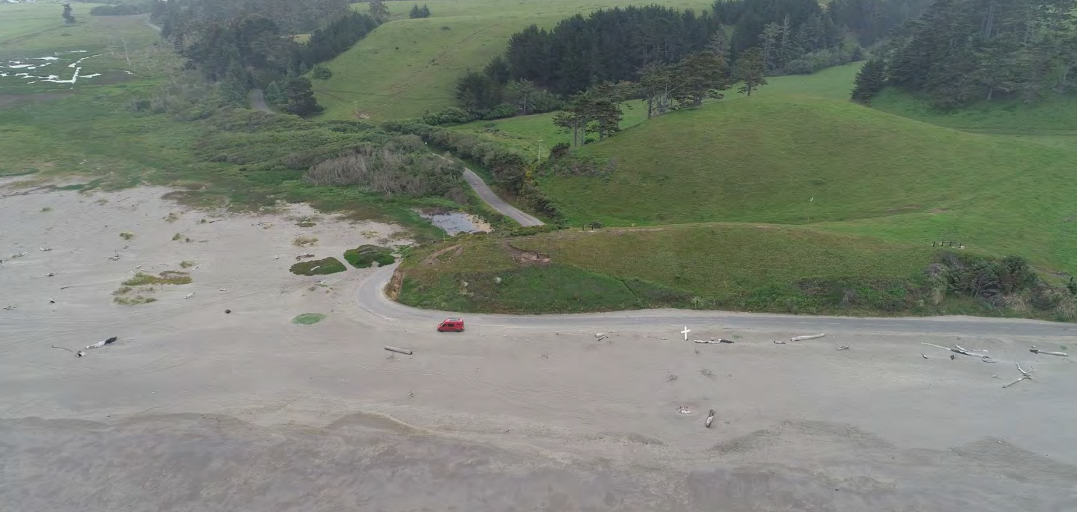
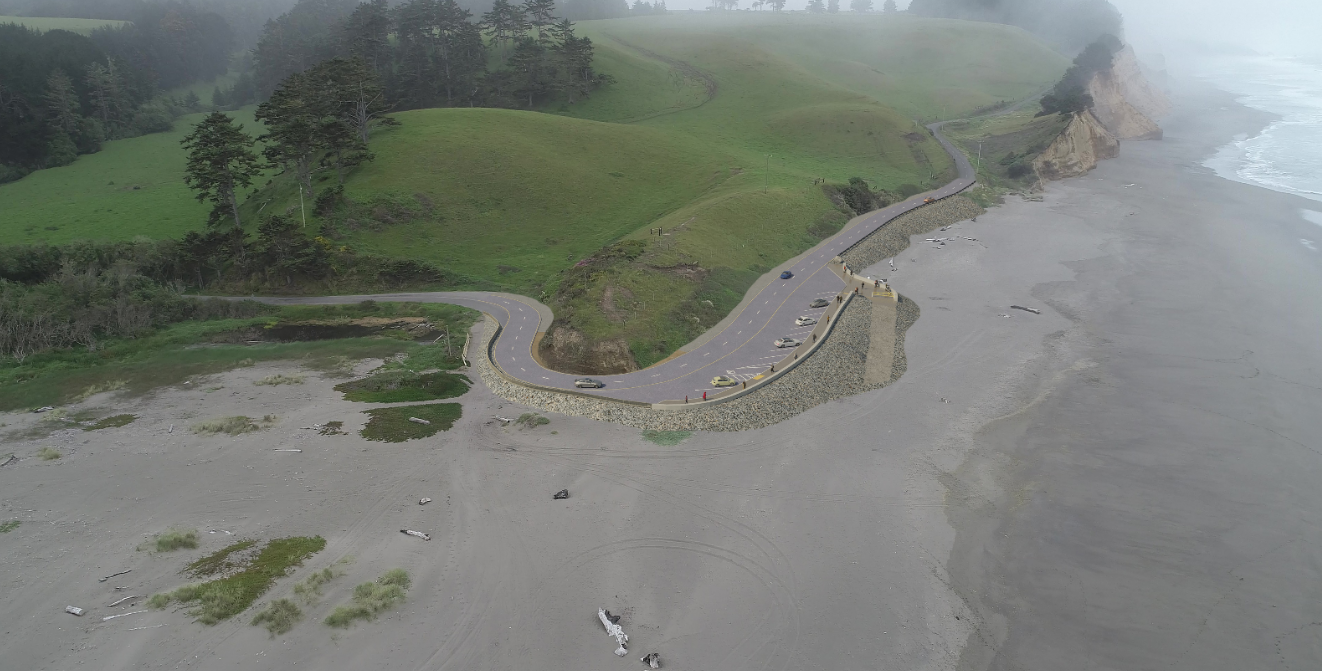
Left: If any road should be moved instead of armored, it’s this one. Right: a rendering of the approved revetment (Humboldt Public Works)
Surfrider asked for a ten-year authorization instead of twenty, stronger accountability on relocating the road, and a commitment to accept forthcoming public access easements adjacent to the park as mitigation. Staff adopted several of our recommendations. The required adaptation plan must now include a right-of-way acquisition strategy, and the County must report its progress to the Commission every other year. Previously the plan was due in five years with nothing required for fourteen years after that. The longer a jurisdiction can wait, the more likely delays and "emergencies" become. The County will be required to pursue an eventual managed retreat alternative. Still, a large revetment on an unarmored coast, where retreat remains possible, should have been avoided.
More at ActCoastal
If your thirst for Commission updates remains unquenched, check out our ActCoastal September Report for an even deeper dive into these key votes, meeting highlights, and more. ActCoastal is our coalition Coastal Commission accountability project; we track every meeting and score important votes as either Pro-Coast or Anti-Coast.
 Mitch served in various volunteer leadership positions with the San Diego Chapter before being hired on as Chapter Manager in 2018. In 2022, he transitioned to the chapter’s policy role. In 2025, he's broadened his scope as California's Senior Policy Coordinator.