
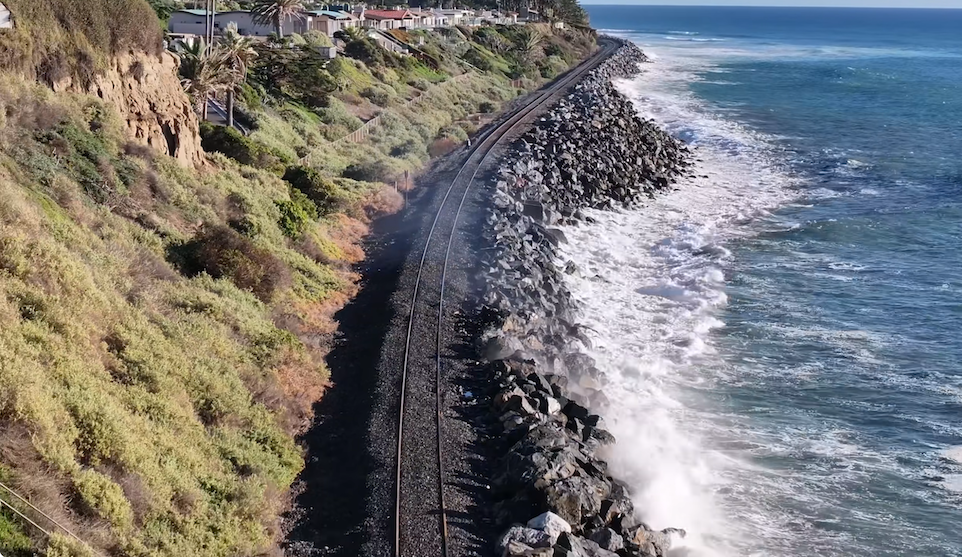
The Commission met November 4–6 in San Francisco, where it addressed coastal adaptation in Santa Cruz, hosted a Local Government Working Group workshop on sea level rise, and approved “one of the largest encroachment impacts the Commission has ever considered in a single CDP” to protect an endangered beachfront rail segment in San Clemente. The permits in Santa Cruz and San Clemente both exposed a major Commission vulnerability, its failure to properly mitigate emergency armoring when it comes back for a required follow-up permit.
Let's dive in.
OCTA Rocks San Clemente's Beaches for Another 10 Years
After several hours of deliberation on Thursday, the Orange County Transportation Authority (OCTA) left with a 10-year permit to retain over 46,000 tons of emergency rock, add more to the existing footprint, and build an additional 1,200-foot seawall across a popular stretch of San Clemente State Beach. All told, a mile and a half of beach will become a pile of rocks, a wall of concrete, or both. As mitigation, OCTA committed to placing 690,000 cubic yards of sand on the beach in front of its armoring, but it’s uncertain whether, or for how long, that sand will stay.
In response to a unified front of coastal advocates, local residents, and tribal representatives calling for OCTA to maintain a walkable beach and minimize its armoring footprint, the Commission amended the permit to require a five-year check-in on how the sand replenishment performs. Depending on the results, the Commission will consider adding a requirement to maintain a passable beach in front of the armoring.
That’s less than what Surfrider and the community asked for, but it’s not nothing. Surfrider also urged the Commission to shorten the timeline for the permit’s Long-Term Adaptation Study and to require a preferred alternative, but those asks fell short. Surfrider would like to thank the many South Orange County chapter members who spoke up at the hearing. It made a real difference.
Select testimony and Commission discussion below, including Surfrider's group presentation:
Lost in the wrangling over this permit were the larger questions: whether this rail segment can be maintained at all, and at what cost to taxpayers and to San Clemente’s priceless public beaches. OCTA has received $305 million in state and federal funding to hold the line for 30 years, despite being unable to reliably keep trains running. The line has been fully closed for 12 months since 2021. Hundreds of millions in taxpayer dollars to fight a losing battle against the ocean, one that is destroying an entire city’s beaches in the process. The rail segment has become a boondoggle, but the powers that be haven’t admitted it yet.
This permit is settled for the next 10 years, but Surfrider will continue to fight for San Clemente’s beaches. At least now there will be a 5-year check-in to assess OCTA’s sand replenishment, and potentially require them to maintain a minimum beach width. Ultimately, this rail segment must be relocated or abandoned.
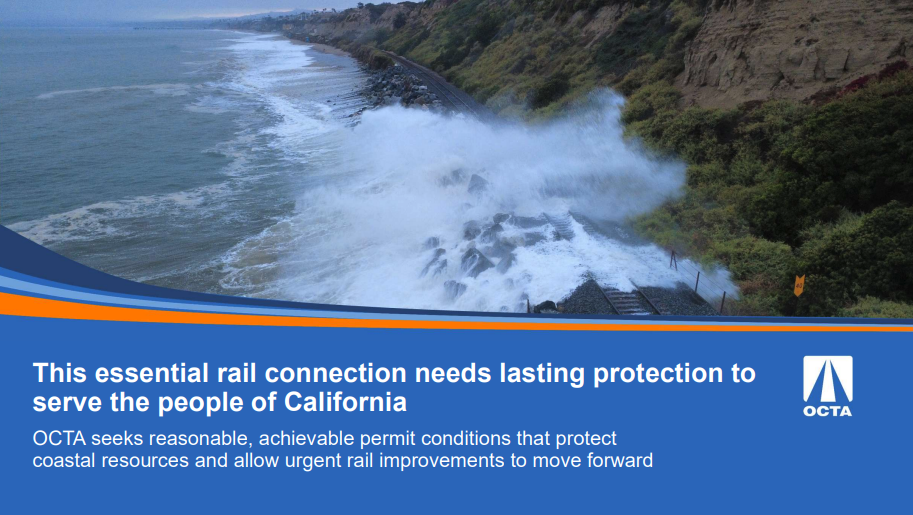 OCTA's own slide raises doubts over the likelihood of "lasting protection"
West Cliff Drive Emergency Armoring Followup, Santa Cruz
The day prior, the City of Santa Cruz received a CDP formalizing approximately 1,200 combined feet of emergency rock and seawalls along West Cliff Drive, most of it built after the 2023–24 and 2024–25 winter storms. In exchange for keeping the armoring, Commission staff worked with the City on a mitigation package that includes a 600-foot landward realignment of West Cliff Drive along Lighthouse Field Park, the only segment of the corridor where this kind of proactive adaptation is immediately feasible. It’s only 600 feet, but it’s an exciting start, because the City’s recently certified Local Coastal Program (LCP) Update contemplates phased realignment of additional segments along the park.
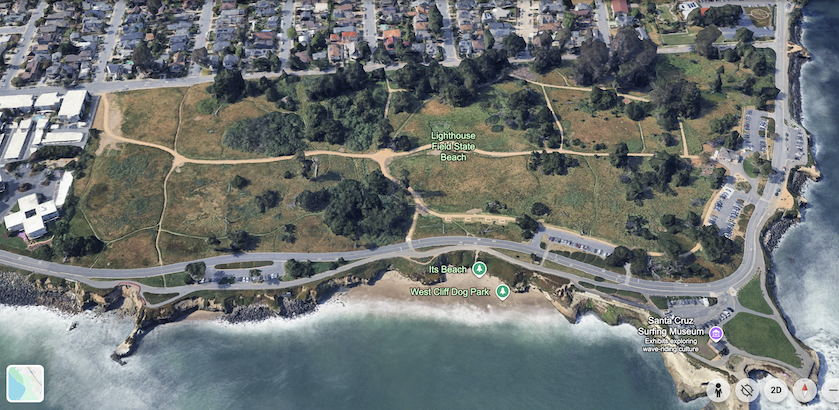 Lighthouse Field Park, where managed retreat of West Cliff Drive is feasible
Ambitious LCP policies like that lack teeth, though. If the City neglects, delays, or abandons those commitments outright, the Commission has little recourse. That’s why Surfrider asked the Commission to make these policies enforceable special conditions of the CDP. City and Commission staff both disagreed, citing the City’s need for flexibility to secure funding and its good-faith progress toward proactive adaptation. The Commissioners ultimately deferred to staff.
Surfrider understands wanting to reward the City for its good work, but this was a missed opportunity. Santa Cruz’s LCP requires armoring impacts to be commensurately mitigated, and that wasn’t demonstrated here. Conditioning those LCP commitments in the CDP would have given the Commission leverage to ensure the City follows through on realigning West Cliff Drive along Lighthouse Field, then removing the boulders from the beaches below. Without that, it’s unclear whether the mitigation for armoring is commensurate with impacts to beaches and sand supply that the Commission values at $18.3 million.
Surfrider testimony, along with some Commission deliberation:
The Emergency to Permanent Permit Pipeline
While the OCTA permit formalized far more armoring, both CDPs expose a back door in the Coastal Act, which Surfrider calls the “emergency-to-permanent permit pipeline” in its recent State of the Beach Report. The pattern is predictable. A storm hits, beaches erode, property or infrastructure is threatened, emergency permits are issued, and rock goes on the beach. “Temporary” armoring becomes permanent, as it did in both Santa Cruz and San Clemente. Full Coastal Act review doesn’t come until it’s too late, after the beach is already gone.
Local Government Working Group Workshop on Sea Level Rise Planning
That segues into Friday’s Local Government Working Group (LGWG) workshop on sea level rise planning. The LGWG brings together Commission staff with local elected officials from coastal cities and counties to work through challenges related to local sea level rise adaptation. For over a decade, they’ve held a public workshop every 2-3 years to discuss progress.
This year’s workshop centered on a draft Call-to-Action document, much of which aligns with Surfrider's priorities and provides useful common ground for coastal advocates and local governments to build on.
For several years now, discussion at these workshops has revolved around a stated need from the LGWG, backed by Commission staff, to move beyond parcel-by-parcel planning toward neighborhood-scale adaptation. The LGWG has since rebranded the concept as “Strategic Coastal Adaptation and Local Enhancement Districts,” or “SCALED” adaptation planning. It remains a major point of contention between the LGWG and Surfrider.
Surfrider supports neighborhood-scale adaptation where it preserves beaches and coastal access through nature-based adaptation. The concern is that it will also be used to justify neighborhood-scale seawalls that further destroy beaches, including in front of structures that otherwise wouldn’t qualify for armoring under the Coastal Act. The Commission’s 2025 approval of Pacifica’s LCP Update did exactly that by creating Special Shoreline Resilience Areas, which relied on a questionable application of the Coastal Act’s conflict resolution provision. By creating a legal pathway for neighborhood-scale seawalls that will likely lead to beach loss, this decision set a dangerous precedent.
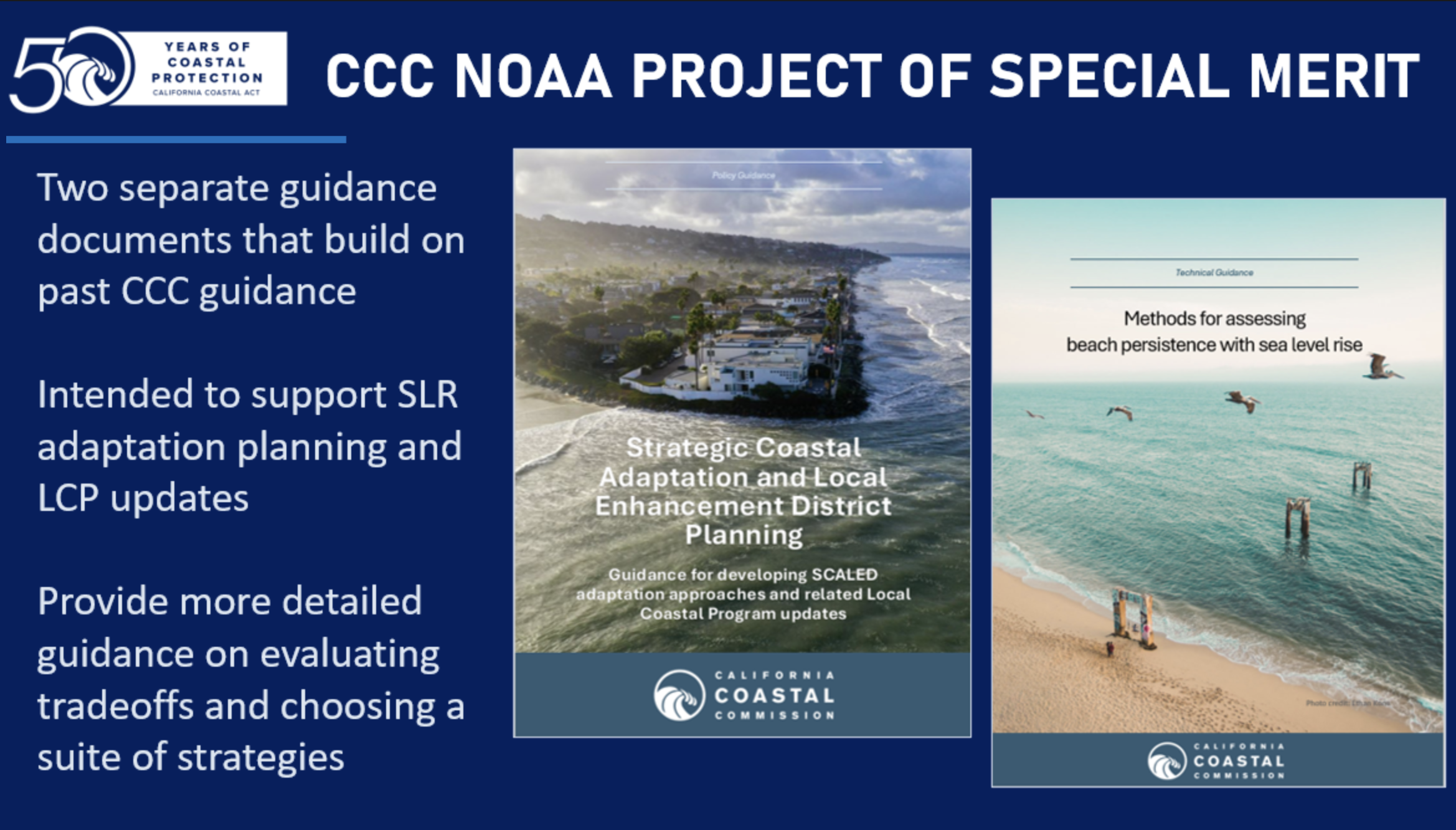
Commission staff is now developing two guidance documents as a result of the LGWG Workshops: one on SCALED adaptation approaches in LCP amendments, and a companion technical guidance document for assessing beaches persistence with sea level rise. Both should be available for public review in December. Surfrider looks forward to reviewing them and will be watching closely to make sure SCALED planning doesn’t become a fast track for armoring.
More at ActCoastal
For a deeper dive into key Commission votes and other meeting highlights, check out the ActCoastal November Report. ActCoastal is a coalition Coastal Commission accountability project that tracks every meeting, and scores important votes as either Pro-Coast or Anti-Coast. Sign up for monthly Commission meeting reminders and followup reports HERE.
 Mitch served in various volunteer leadership positions with the San Diego Chapter before being hired on as Chapter Manager in 2018. In 2022, he transitioned to the chapter’s policy role. In 2025, he's broadened his scope as California's Senior Policy Coordinator.